“I argue that for humans to stop treating animals as exploitable ‘things,’ we must actually continue to have relationships with them, relationships that are not shaped by ownership (pets), spectacle (zoos), or exploitation (eating them), but by interdependence…”
-Sunaura Taylor

Self portrait with Manatee, courtesy of Francis J. Greenburger Collection, New York
Sunaura Taylor is a painter, writer, and activist whose work emphasizes connections between disability politics and the rights of non-human animals.
On the gallery’s west wall are two self-portraits in which the artist highlights the relationship between her body and the body of non-human animals. Self-portrait with Moose and Self-portrait with Manatee ask that viewers look at bodies of animals and humans in ways that emphasize connection rather than difference.
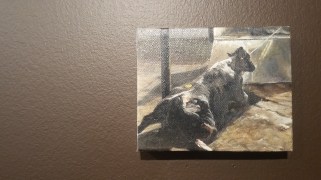 The works in the gallery include 7 small paintings of animals that draw attention to the exploitation of non-human animals in factory farms. The factory farm paintings depict felled cows, culled chickens, and dead lambs.
In an altered artist book, Taylor places her own figure in the pages of a book about arctic animals. When visitors flip through the pages of the book, they find the human figure positioned in intimate and often vulnerable relation with polar bears and bison. The works demand that we move away from relationships based in exploitation and toward a recognition of our ethical responsibilities to recognize human and non-human interdependencies.
Taylor holds an MFA from the University of California at Berkeley and is a PhD student in American Studies at New York University. She is at work at a book titled Beasts of Burden, which explores the deep entanglements of disability and animal justice. By taking up a process that she calls “cripping animal ethics,” Taylor compels her readers and viewers to think deeply, sometimes uncomfortably, about what separates the human from the animal, what divides the disabled from the nondisabled, and what it might mean to break down these divisions.
Sunaura Taylor Selected Works 2008-2016 is curated by femlab’s gallery director, Michelle Meagher, with the assistance of Tashina Makokis in coordination with the Decolonizing Critical Animal Studies, Cripping Critical Animal Studies conference hosted at the University of Alberta June 21-23, 2016 and organized by Chloe Taylor and Kelly Struthers-Montford. Sunaura was a speaker at this conference, and her work was the topic of a plenary discussion by leading feminist disability scholar Alison Kafer.
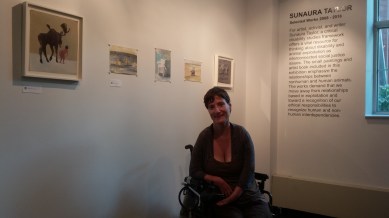 We were thrilled to host, with CAS/CCAS, a reception with Kafer, Taylor, and other conference participants on June 22nd. Check back here for news about a closing reception, tentatively scheduled for September 14th. For more information, why not visit the artist’s webpage, http://www.sunaurataylor.com
Self Portrait With Moose and Self Portrait With Manatee appear courtesy the Francis J. Greenburger Collection, New York. All other works appear courtesy of the artist. Special thanks to Blair Brennan, FAB Gallery and to Natalie Loveless, HDVAC and the Research-Creation and Social Justice CoLABoratory.
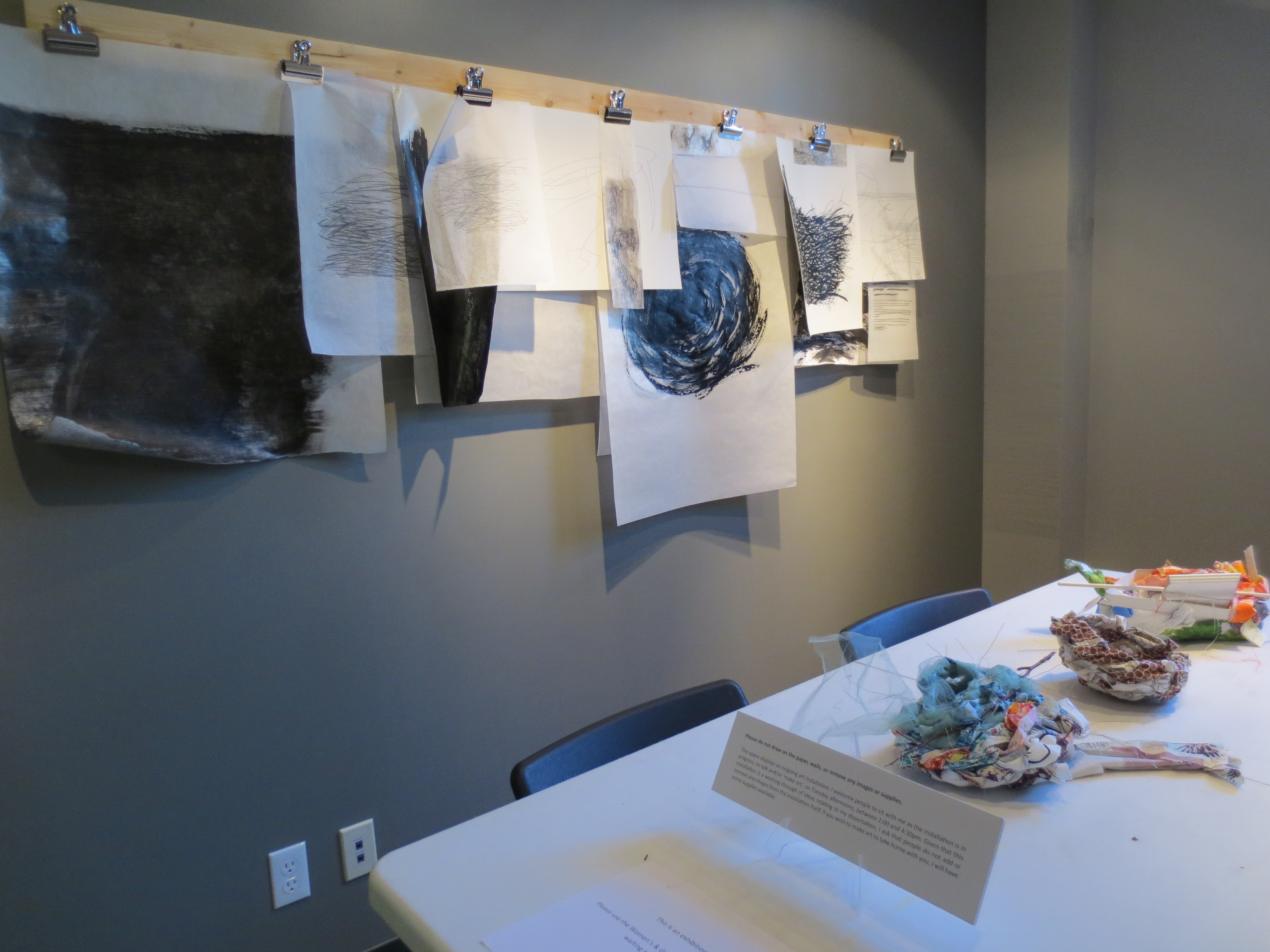
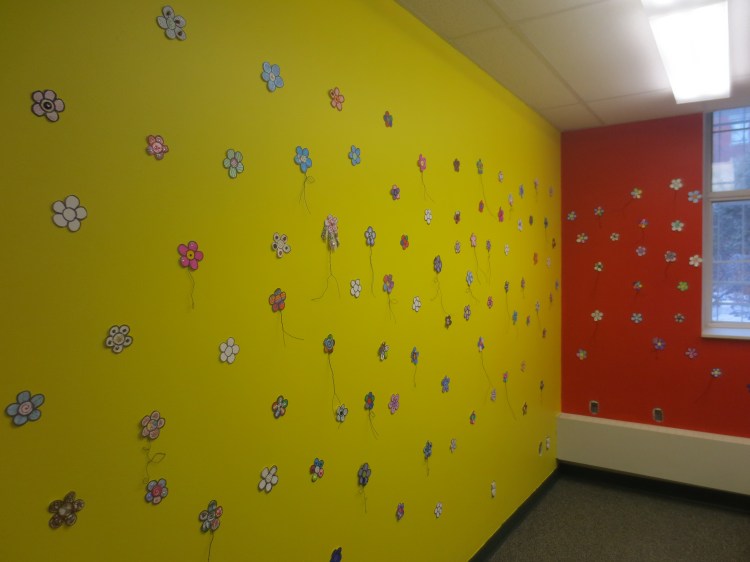 Beginning in September 2015, BFA student Damien Potts, Lori Myers, an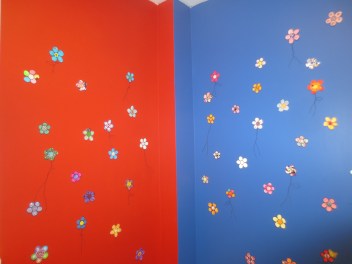
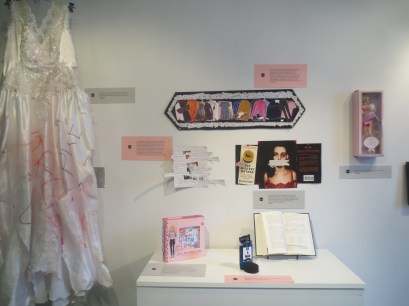 Students in WGS 101 Representations of Girls and Women were posed this question in Fall 2015. 120 students were asked to produce creative projects that reveal, transform, challenge, subvert, or otherwise expose the ways that gender – shared and largely taken for granted ideas about masculinity and femininity – are embedded in the objects, images, and artifacts that surround us daily.
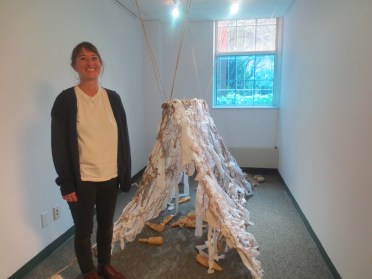 Beer Tent for Girls evokes the excitement of discovery – the discovery of forbidden spaces, the discovery of autonomy, and the discovery of youthful rebellion. Nickerson’s beer tent – handwoven with thick, burlap twine and off white and pink strips of fabric – hangs precariously from the ceiling and is held down temporarily by rocks collected from local gardens. A hidden drinking camp for women and girls, this musty beer tent beckons rebellion and gives the finger to the often stringently patrolled gender roles that position “good” girls in domestic settings.
 The Who Needs Feminism campaign was started by students at Duke University who wanted to challenge widespread misconceptions of feminism in contemporary Western culture. These students provoke their interlocutors to reconceptualize definitions of feminism.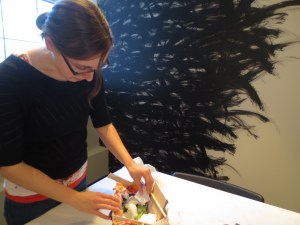
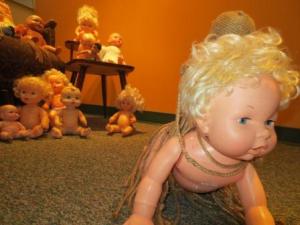 Lucille Frost’s Plaything (2012) is a multi-media installation that includes a looped 6 minute video and dozens of children’s dolls.
 femlab